

Electrical Systems Engineering DEPARTMENT
Word from the Head of Department
Pr. Messaoudi Norddine
- CSD
- Head of Specialties
PRESENTATION OF THE Department of Electrical Systems Engineering (DISE)
The Department of Electrical Systems Engineering (DISE) is one of the four departments of the Faculty of Technology. In the Licence cycle, the ISE department contains five sections (Automatic, Electronics, Electrotechnics, Biomedical Engineering and Telecommunications) and a program with a Master’s Integrated License Curriculum (MCIL) in Automatic. In the Master cycle, each Licence section has a specialty in Master (see the following flowchart). Our department also provides training in Electrical Engineering.
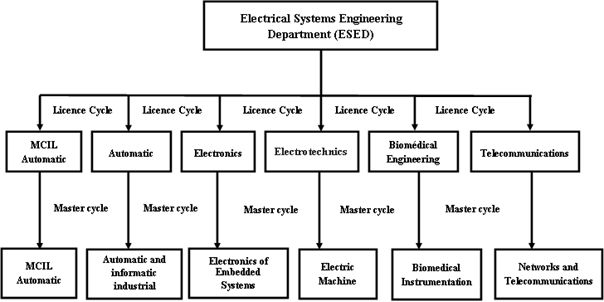
Pedagogical organization chart of the department
The diplomas delivered by the Electrical Systems Engineering department are of great importance in the professional and industrial world (factories, hydrocarbons, renewable energies, medical instruments, the world of telecommunications, etc.).
In what follows, we will describe the areas of intervention of the five specialties provided within our department:
- Automatic is part of the engineering sciences. This discipline deals with the modelling, analysis, control and regulation of dynamic systems. Its theoretical foundations are mathematics, signal theory and theoretical computer science.
Automation allows the automation of tasks by machines operating without human intervention. We then speak of a controlled or regulated system.
- Electronics are involved in all areas these days. But when we take a closer look at its benefits, it is electronic products that first attract attention, including mobile phones, computers, televisions, etc.
Indeed, electronic products are multiple and multifaceted with advantages as varied according to their field of use. Mainly, when we dwell on mobile phones and the computer, we realize that electronics has revolutionized the world through the historic invention of the electronic chip. This chip remains the essential element in the manufacture of these essential products in the daily life of man. For example, the advent of mobile phones makes it easier to communicate. The computer, the television, etc., give an opening to the world. The impact of electronics in our daily lives is great.
- Electrotechnics refers to the study of technical applications of electricity. In reality, electrical engineering brings together the disciplines dealing with electricity as energy. Mention may be made of the production, transport, distribution, treatment, transformation, management and use of electrical energy. Sometimes called Electrical Engineering, its birth can be traced to the invention of the dynamo in 1869.
- Biomedical Engineering is a branch of engineering aimed at the control of biological systems or the development of devices for the diagnosis and treatment of patients. This interdisciplinary field of development and research is a mixture of medicine, biology, engineering and physics. This sector of activity includes: Bioelectricity, bio-electromagnetism, bioinformatics, biomechanics, and study of biomaterials, electrophysiology, and evaluation of medical technologies, physiological regulation, biomedical instrumentation (including imaging medicine), biomedical modelling, biomedical image and signal processing.
- Telecommunications include all the combinations of remote information transmission, ensuring rapid exchange of information. In a company, communication is essential both externally and internally. Nowadays, thanks to the digital revolution, it is increasingly easy to remotely exchange quickly. The exchanges can be carried out in writing, orally, or by image. Everything is connected! A good network makes it possible to ensure the best synergy of the different tools allowing a company to develop and increase its turnover.
LICENCE
| Branch | Speciality | No. Order |
| Electronics | Electronic | n°1058 of 09 August 2016 |
| Electrical Engineering | Electrical Engineering | n°1058 of 09 August 2016 |
| Automatic | Automatic | n°709 of 05 August 2016 |
| Telecommunication | Telecommunication | n°709 of 05 August 2016 |
| Biomedical engineering | Biomedical genius | n°709 of 05 August 2016 |
MASTER
| Branch | Speciality | No. Order |
| Electronic | Embedded systems electronics | n°1207 of 09 August 2016 |
| Electrical Engineering | Electric machine | // |
| Automatic | Automation Industrial and computing | // |
| Telecommunication | Networks and telecommunications | // |
| Biomedical engineering | Biomedical Instrumentation | // |
